
Drones, AI, IoT & Technologies Serving Law Enforcement

UAE: AI and Drones Central to Public Safety
In October 2024, the Dubai Police announced the creation of the “Digital Transformation and Artificial Intelligence Council”, whose mission is to boost digital transformation efforts by adopting cutting-edge technologies to help the security forces, while integrating artificial intelligence into these operations still further. It is a fact that AI is already revolutionising policing in the Emirates.
In Sharjah, it is being deployed for several purposes. Surveillance systems now use artificial intelligence to detect threats early on and alert the authorities immediately. It is also used to manage traffic, reduce incidents and improve traffic flow for more effective road safety.
In Dubai, AI is used to analyse huge amounts of data, identify criminal trends and predict incidents, thus optimising the allocation of police resources.
Another leading-edge technology used by the Emirati security forces is drones, which can monitor large urban areas, particularly any that are hard to access, and provide a bird’s eye view of the city. Equipped with high-resolution cameras and sensors, they can be used to track criminals or locate missing persons.
The Dubai Police has also announced a collaboration with AirHub, a global provider of drone fleet and operations management software. As a result, Dubai is setting up a Drone Operations Centre to coordinate drone swarms, currently under development. This rollout shores up a “Drone as a First Responder” programme designed to support everyday police activities.
Canada: a Connected Royal Canadian Mounted Police
In Canada, drones are fully integrated into the missions of the Royal Canadian Mounted Police (RCMP). “Drones are becoming more widespread within the RCMP and police services in general," said Paul BRUCE, drone programme manager with the RCMP's Air Services Branch. "Law enforcement agencies around the world are using drones to respond to calls, gather evidence, search for missing persons, respond to emergencies and even participate in community policing.”[1]
Here again, a “Drone as a First Responder” programme is being developed in Alberta. The drones, positioned on rooftops within patrol areas, are poised to take off at any time, weather permitting. The drone pilot can collect live video information transmitted by a drone and relay it to ground patrols.
“This means that we can improve risk assessment for police officers before they arrive. Normally, these updates come to us from radio operators, with a slight delay. Live feedback is thus a real asset,” says Anthony SETLACK, chief pilot at several sites during tests.[2]
AI is also central to the new technologies that law enfrocement agencies are integrating into their investigations. It is particularly useful for speeding up investigations involving the suspected sexual exploitation of minors. It is also used to automatically read number plates and for data filtering and extraction.
France: Homeland Security Technologies on the Rise
In France, too, the use of drones by security forces is growing rapidly. There is an increasing need for fleet management during complex operations like infrastructure surveillance, civil security or defence missions, fire detection and border surveillance.
To meet these challenges, GeoFencing is developing a drone swarm management platform designed for operators running ten or more craft. Supervised from a control centre, the solution can manage both autonomous and coordinated swarm missions.
An on-board system, co-developed with the CNRS and the Italian Aerospace Research Centre, provides very high-speed communication and high-definition video streaming.
“The AI control algorithms run on the ground, which is much more efficient,” says GeoFencing president Samuel BRAU.[3] A ground station can also track flights in real time, and enable operators to take control of an autonomous drone or fly it remotely.
The company is working with civil security authorities on a forest fire prevention system, where cameras mounted on a water tower detect smoke within a radius of 350 km², geolocate the anomaly, and trigger the dispatch of a drone to check the situation, or even of several if intervention is needed.
GeoFencing also offers an operational mission management platform in parallel: preparation, regulatory documentation, remote pilot monitoring, maintenance, resource booking and the provision of flight authorisations.
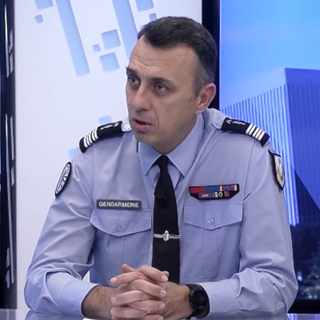
AI is gradually making its way into the French National Gendarmerie to assist forces in their missions.
"AI is a tremendous opportunity for internal security forces, as it encompasses every sphere – strategic, tactical and operational alike. Firstly, it provides gendarmes with considerable support in carrying out their operational missions.
One example is the application of automatic speech transcription, designed to facilitate the processing of telephone wiretaps in criminal investigations.
AI is also used to analyse large volumes of video footage, enabling far faster searches than those achieved by humans, particularly when it comes to detecting child pornography.
In tactical terms, artificial intelligence is a fundamental tool for helping to devise manoeuvres to assist company and group commanders, notably through methods for the predictive analysis of crime trends.
Lastly, at strategic level, AI can be used to analyse and anticipate the allocation of resources and means more efficiently," says General Patrick PATRICK, AI coordinator within the National Gendarmerie and AI advisor to the Ministry of the Interior's Cyber Command (COMCYBER-MI).[4]
And that's not all. Connected bulletproof vests recently made their appearance in the Gendarmerie. The result of a partnership between the DGGN (National Gendarmerie Directorate General) and Wearin', a Swiss start-up, the device can be triggered manually via an SOS button, or automatically in critical situations, e.g. man-down or perforation of the vest by a blade or bullet.
Once the alert is activated, the officer's geolocation is transmitted immediately. The connectivity kit is powered by a central battery that provides up to eight hours’ autonomy. It powers all the officer's electronic equipment and is easily recharged with a single cable, which the officer can connect to their vehicle or at the end of their mission.
The entire system, including the Wearin' battery, the “Wearin' Brain” smart module and the quick-release system, is ergonomically incorporated into the vest. Optic fibres integrated into the front and back ensure better visibility during night-time operations.
And last but not least, the Gendarmerie is getting ready for the arrival of quantum technology. Several challenges have been identified: quantum computing to break today's criminal encryption codes in the future, the transition to post-quantum encryption algorithms to protect us from risks, as recommended by the ANSSI (French National Cybersecurity Agency), and quantum sensors with enhanced detection capabilities, particularly useful in the fight against drugs and explosives.
The Gendarmerie also applies the Harvest Now, Decrypt Later principle: “We collect data today and decipher them tomorrow,“ says Colonel Nicolas DUVINAGE, adding: “Some investigations are resolved very quickly and the data don’t have a very long lifespan. But others go through a very long legal process.“[5]
To continue innovating and remain in the forefront of innovation, the French Gendarmerie is looking to recruit in these areas.
[3] Article S&D Magazine: La filière sécurité et défense à la pointe de l’innovation
[5] Article Challenges : Cybersécurité : comment la gendarmerie passe à l’ordinateur quantique